Short answer
To validate thousands of promotion receipts without manual review you combine three pieces: OCR to pull the text out of the photo, a language model to interpret it, and rules in code that make the decision. At Panini Fan Zone FWC 2026 that flow verified receipts against a fixed pool of 80,000 folios, processing in batches every two minutes.
The problem: thousands of receipt photos and nobody to check them
In a promotion, every participant uploads a photo of a receipt or proof of purchase. Checking them by hand is slow, expensive and error-prone. Accepting them unchecked invites fraud. The challenge is to automate the review without losing control.
The architecture, step by step
The solution combines a fixed pool of folios, automatic reading of the image, interpretation by a language model and rules in code that make the final call. Each piece has a single job, and processing happens in batches so that a spike in participation doesn't take the site down.
- A fixed pool of folios. All 80,000 folios exist from the start and are assigned atomically: two people can't get the same folio even if they sign up in the same second.
- OCR. Tesseract extracts the text from the receipt image.
- LLM. A model (LLaMA 3.3 70B via Groq) interprets that text and returns structured data.
- Rules in code. The model proposes; the code decides. Business rules are checked in code, never only in the model's answer.
- A cron job every 2 minutes. The system works through the queue in batches, so a participation spike doesn't bring the site down.
It all lives in two custom WordPress plugins, built with PHP and MySQL. The full story is in the Panini Fan Zone case.
What failed and how it was fixed
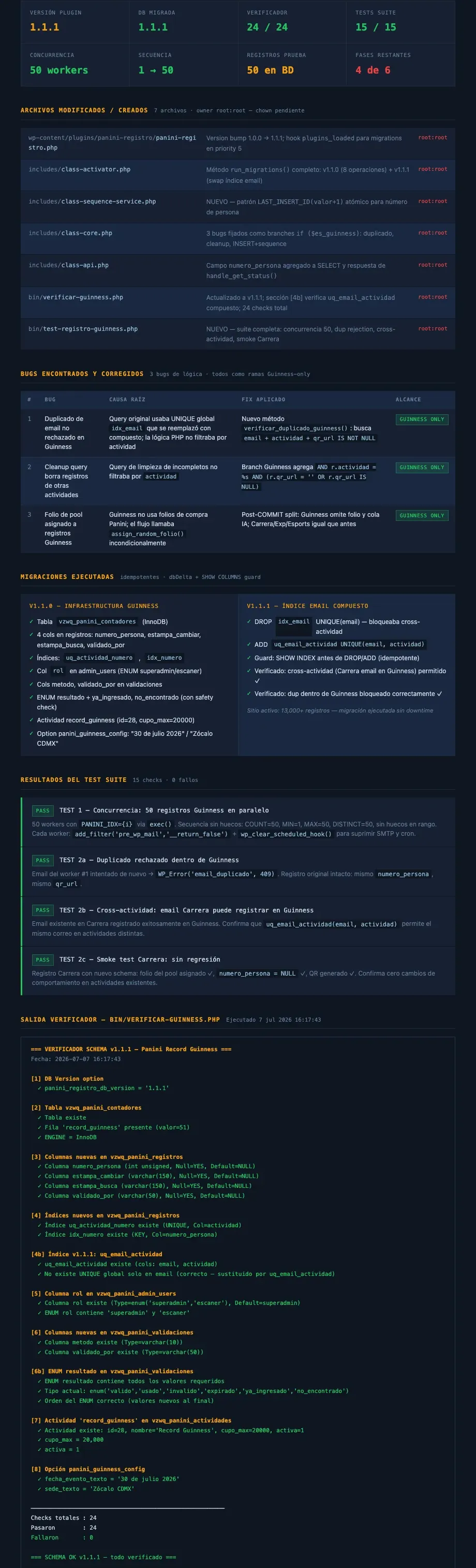
The Guinness World Record registration needed its own rule: one person, one entry, scoped to that activity. The first version of the uniqueness index checked email globally instead of per activity, which let the same email register twice under different activities. I migrated the schema to a composite unique index scoped to the activity, added a guard that checks the existing schema before altering it, and bumped the plugin from v1.1.0 to v1.1.1. After the fix, the system passed 15 out of 15 tests, including the concurrency test, and 24 out of 24 checks of the record module.
Why not leave everything to the AI
A language model is excellent at reading messy receipts, but it can be confidently wrong. That's why the AI only proposes and the rules decide. When there's no certainty, the receipt is flagged for review instead of being approved.
Where else this pattern works
The same pattern (sign-up, atomic assignment, automatic validation and a live count) applies to other campaigns I've built. In The ECCO Walk, a community counter went from 72,672 to 3,532,137 steps in one week without becoming inconsistent. In Caravana, a redemption system with real money closed operations at 5 PM local time across several time zones.
Related: Panini Fan Zone case
FAQ
Can the AI approve receipts on its own?
It can propose, but it shouldn't decide alone. In my architecture the model extracts and structures the data, and rules written in code approve or reject. Anything doubtful is flagged for human review.
How long does it take to build a platform like this?
It depends on the promotion's rules and the expected volume; a typical campaign takes 4 to 8 weeks.
Does it work with receipts from any store?
OCR reads any legible image, but each receipt format needs its own rules. It's worth testing with real samples from the participating chains before launch.

Samuel Torres Pichardo · Software and Cloud Engineer · Mexico City
I run more than 23 sites in production.
About me · LinkedIn
Want something like this for your business?
Get a quote on WhatsApp in 2 min