In short
- Your site is a 24/7 salesperson: when it ages, it sells less and nobody tells you.
- Google indexes the mobile version, and its ranking systems use Core Web Vitals.
- To appear in AI search, Google asks for no special optimizations: it asks for good SEO.
- Renewing is not starting over: at Conqr the design, titles and URLs were kept, with 341 redirects from Wix.
- A good redesign goes in phases: inventory, foundations, measured build, autonomy, launch and polish.
Your website is the only salesperson who never goes home. It takes calls at three in the morning on a Sunday, from a phone in Monterrey or a laptop in Madrid. The question isn't whether it works. The question is how well it sells.
This year I watched a very clear case up close. Conqr, the Mexico City agency where I work, had its site on Wix. When the domain moved, that site stopped answering. To find out which pages had existed, its URL map had to be rebuilt from the Wayback Machine, which kept the text and the layout, but not the images.
Then came an HTML concept. It was beautiful, but sealed: the copy lived in a single logic file, and the images and even a video were packed inside data files. Nobody on the team could change a comma. In 9 days I turned it into a living platform on WordPress: bilingual, editable by the team and with its own 3D engine. The visual design belongs to Conqr's design team. My part was development, architecture, infrastructure, migration and launch.
I'm not telling you this to show off. I'm telling you because, along the way, I saw one by one the signs of a site that has aged. And almost all of them apply to any business website in Mexico.
8 signs it's time to renew your website
- Changing a sentence means calling someone. If every tweak needs a quote, the site freezes. A beautiful site nobody can touch ages in weeks.
- On a phone it looks small, slow or cut off. Your clients look you up on their phones. If the mobile version is the "trimmed" one, that's your first impression.
- The page jumps while it loads. You go to tap a button and it moves. That has a name, it can be measured, and it scares clients away.
- You don't know which pages you have or where they lead. If you switched platforms tomorrow, would you know which URLs to redirect? At Conqr there was no sitemap at hand, and it had to be rebuilt.
- Your platform has you locked in. You can't take your site with you, or you depend on a single vendor, or on the one person who "knows how it was built".
- You sell in two languages, but your site speaks one.
- Contact forms arrive… sometimes. Nobody knows for sure whether messages get through, or whether your domain's email is set up properly.
- It no longer looks like what you sell today. Your business grew, your offer changed, and the site still tells the story from years ago.
Recognized two or more? Further down there's a 10-question self-check.
What changed on the web: a website redesign is no longer a new coat of paint
A few years ago, renewing meant "a fresh look". Today a site is judged by different rules. These are the ones I care about most, each with its official source.
Mobile first
Google uses the mobile version of your content, crawled with its smartphone agent, for indexing and ranking. It says so in its mobile-first indexing guide. In other words: what Google reads is what you see on your phone. That's why at Conqr every section was checked on desktop and on several phone profiles.
Core Web Vitals
Three metrics of real-world experience. According to web.dev, a site is in good shape if its main content shows up within 2.5 seconds (LCP), if it responds to an interaction within 200 milliseconds (INP) and if its layout shifts 0.1 or less (CLS), measured at the 75th percentile of page loads. Google states in its page experience documentation that its ranking systems use these metrics.
Remember the "page jumps" sign? That's CLS. In the reconstruction of the concept we used for QA, it reached 0.94. On the new site it's 0 on all five pages we measured.
AI search: SEO + GEO
More and more people find businesses through AI-generated answers. The industry calls optimizing for those engines GEO. Here's a fact that lowers the anxiety: Google says in its guide to AI features in Search that there are no additional requirements or special optimizations needed to appear in AI Overviews or AI Mode. What it asks for is the usual: the page must be indexed and eligible to show with a snippet, important content should be in text, the page experience should be good, and structured data should match what's visible.
My take: good GEO starts with good SEO.
Structured data
A standardized way to tell search engines what each page is: an article, a service, a frequently asked question. Google explains it in its introduction to structured data and recommends the JSON-LD format. Conqr ended up with JSON-LD, a unique meta description per URL, Open Graph, hreflang and a sitemap of 151 URLs, all returning 200 and indexable.
Security
One of Google's page experience self-assessment questions is whether your pages are served securely, that is, over HTTPS. But security is more than the padlock: it's an up-to-date platform, backups, a firewall and clear rules. At Conqr, for example, email goes out signed, with SPF, DKIM and DMARC passing.
Accessibility
MDN defines web accessibility as enabling as many people as possible to use websites, even when their abilities are limited in some way. In practice: good contrast, keyboard navigation, alt text, and respect for people who ask their system for less motion. At Conqr, smooth scrolling turns off when a visitor has "reduce motion" enabled, and if the device has no WebGL, a still image replaces the 3D figure.
Interactive experiences
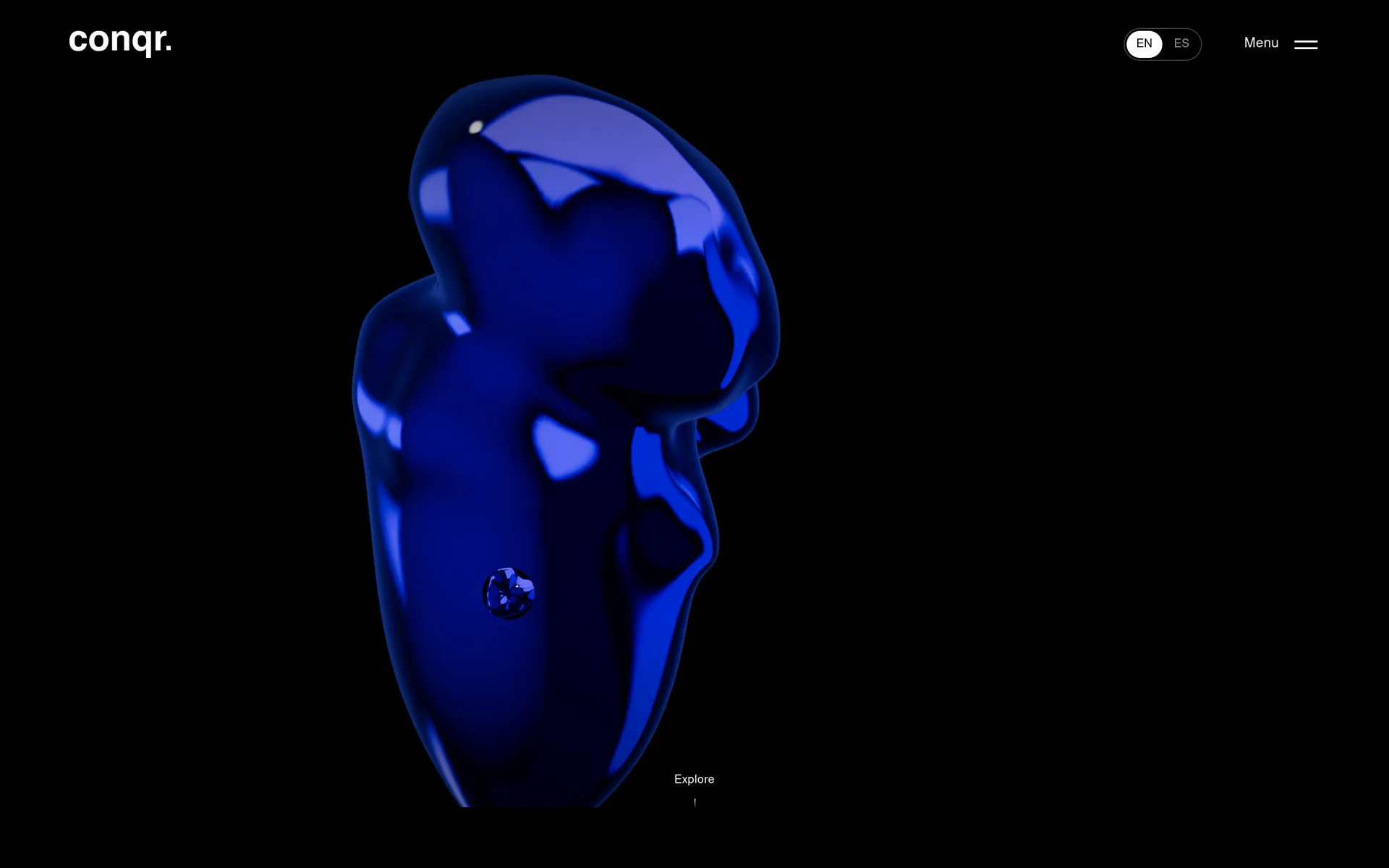
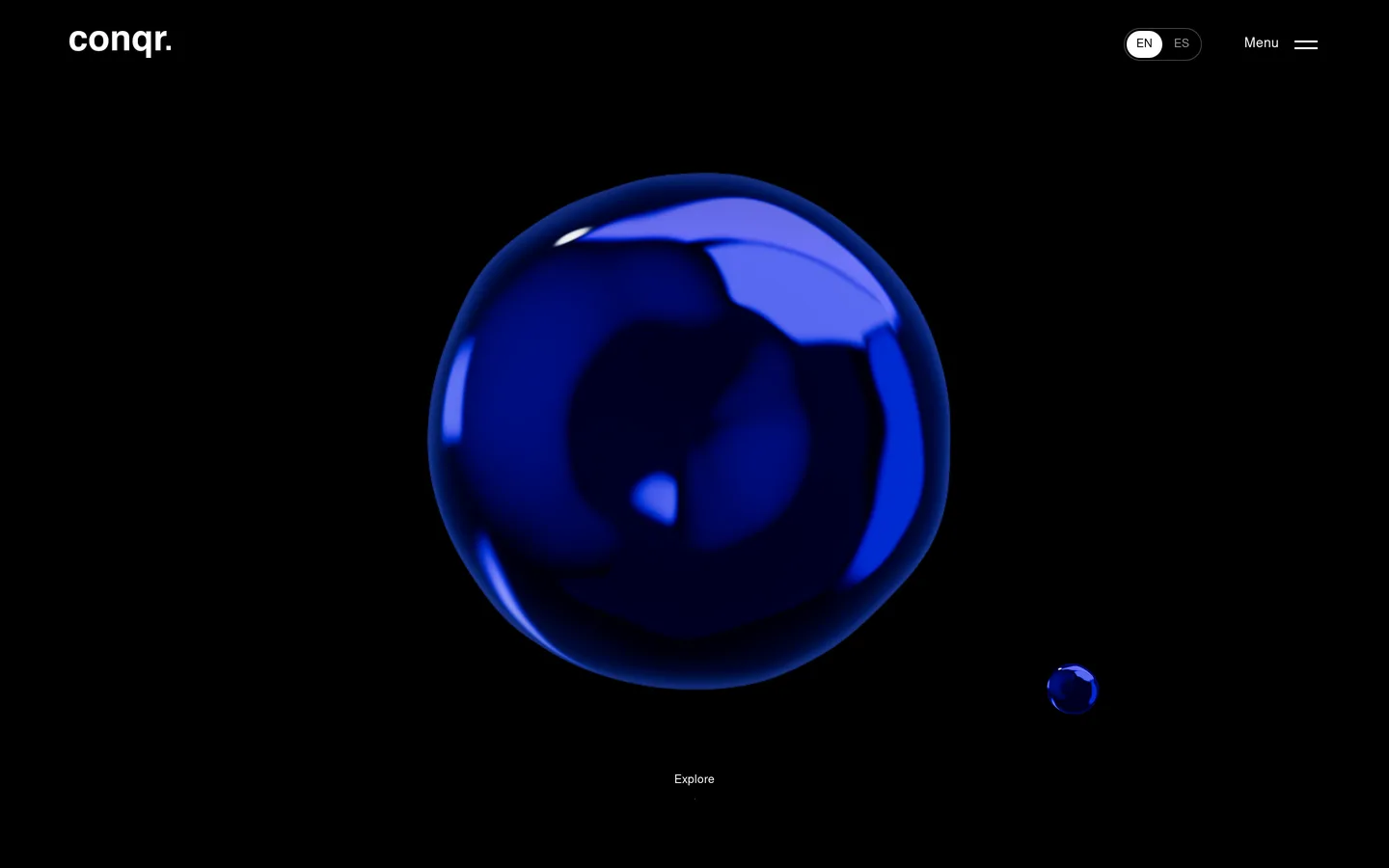
Conqr's chrome figure used to be a video; now it's a 3D object that reacts to the cursor and to touch. But interactivity is only worth it when it's measured: on desktop, the engine spends 1.75 ms of JavaScript per frame, well under the 16.7 ms that fit in one frame at 60 fps. If you want to know how to do it without killing performance, I explain it in how to integrate a 3D engine into your website.
Renewing is not starting over: migrate to WordPress without losing what works
The most common fear I hear is "if I renew, I lose everything". It doesn't have to be that way. Renewing well means keeping what's valuable and changing what gets in the way.
- The design you already like is respected. At Conqr the rule was "when in doubt, the original rules". Not by eye: we measured every piece against the original, and the header and menu came out with a 0.00 px difference. Measuring also exposed bugs in the original, like a footer that overflowed on mobile. Those were not copied.
- Your old URLs aren't lost. We set up 341 301 redirects from the Wix site: 15 to their exact equivalent and the rest to the home page of their language. The 152 old blog URLs also point to their new address.
- Your titles and descriptions stay. Yoast took over the sitemap and titles without losing a word.
- Your team gains autonomy. This is why I usually recommend migrating to WordPress with a visual builder: we reviewed 162 sections, 136 edit with a direct click, 26 from the WordPress editor or on their own, and none was left uneditable. The team got a 6-page guide with real screenshots.
WordPress isn't the answer to everything. But if your problem is "nobody can change anything", it's a very good answer.
The cost of not renewing
I won't give you a percentage of lost sales. I haven't measured it for your business and I won't make it up. What I can describe is what that cost looks like, because I've seen it:
- Prospects who leave without a word. A site doesn't tell you how many people arrived, didn't find what they needed and went to a competitor.
- A team that stops updating. If changing a sentence is a hassle, nobody changes it, and the site signals neglect.
- The risk of losing it overnight. When Conqr's Wix site stopped answering, there was no old site to keep running in parallel. The URL inventory came out of an internet archive.
- Debt that keeps growing. Every month you wait, the jump gets bigger.
- Search engines reading your worst version. If Google indexes your mobile version and that's the neglected one, that's the one competing.
What a well-done website redesign looks like, phase by phase
A good process doesn't start with design. It starts with an inventory. This was Conqr's real timeline, from October 22 to 30, 2026: 9 calendar days and 6 working days.
| Phase | What happened at Conqr | What it means for you |
|---|---|---|
| 1. Reconnaissance | One afternoon (Oct 22) to inventory every section: what it shows, what it animates and what needs custom code. | Someone understands what you have before touching it. |
| 2. Foundations | Child theme, two languages, content types and global styles taken from the original (Oct 22). | A tidy base that doesn't break as it grows. |
| 3. Measured build | Header, intro, menu, Home and inner pages, compared against the original on desktop and mobile (Oct 22–27). | Verifiable criteria, not "looks similar". |
| 4. Editable by anyone | 162 sections reviewed and a 6-page team guide (Oct 27–28). | Your team can update without depending on anyone. |
| 5. Content, SEO and speed | 8 services, a blog with 20 EN↔ES pairs, hreflang and JSON-LD. The Home went from 3.99 to 766 requests per second with 10 users. | Ready for search engines and real traffic. |
| 6. Launch | 16 minutes (Oct 30, 00:24–00:40), with a 9-minute "coming soon" page while we tested. Then, the 341 redirects from Wix. | Nobody sees a half-built site. |
| 7. Polish | Smooth scrolling, page transitions and a favicon that adapts to light and dark tabs (Oct 30). | The details that separate correct from memorable. |
Behind that table there's a method: 135 backup points, one before every change, and 122 work reports, one per step. I used Claude and Claude Code as AI copilots. AI speeds things up; I direct, decide and verify.
And since an honest process also tells you what went wrong: at launch, the domain's DNS ended up with no mail records and the inboxes stopped receiving. It was flagged on the spot, and the records were restored around 2:00 a.m. That night left a rule I now always apply: check DNS against a public resolver before calling a launch done.
One important caveat: 9 days were possible because the design already existed and was defined. Your project may take more or less. What doesn't change is the order.
Self-check: is it time to renew your website?
Ten yes-or-no questions. Answer thinking about your site as it is today, not as you'd like it to be.
Frequently asked questions
- How long does it take to renew a website?
- It depends on the scope and on whether the design already exists. At Conqr, with a design already defined, it took 9 calendar days and 6 working days, from first reconnaissance to final tweak. If the design is also made from scratch, it takes longer. The first step is an inventory of your current site, so the timeline is realistic.
- Will I lose my Google rankings if I switch platforms?
- The risk is real if old URLs are left with nowhere to go. That's why every old URL should get a 301 redirect to its new address or to the closest page. At Conqr we set up 341 redirects from Wix, and titles and descriptions were kept.
- Does my site have to go offline while it's being renewed?
- No. The new site is built separately, in a test environment hidden from search engines, and published behind a gate. At Conqr, the move to the final domain took 16 minutes: for 9 of them, visitors saw a "coming soon" page with the right status code for search engines, never a half-built site.
- Why migrate to WordPress?
- For autonomy: with WordPress and a visual builder, your team changes copy, images and order without depending on a developer. At Conqr we reviewed 162 sections and none was left uneditable. It isn't the answer for every project, but if the problem is that nobody can change anything, it's a very good one.
- Do I need separate optimization for AI search (GEO)?
- According to Google Search Central, there are no additional requirements or special optimizations needed to appear in its AI features. What counts is the usual: your site is indexed, important content is in text, the page experience is good, and structured data matches what's visible.
- Do I need animations or a 3D engine for my site to work?
- No. Interactivity adds value when it serves your brand and is measured so it doesn't slow the site down. If you're curious, I explain how in the article on integrating a 3D engine into your website.
The next step: a diagnosis of your site
If the self-check got you thinking, here's a simple proposal: let's talk about your site. I'll look at what's worth keeping and what's worth changing, and tell you honestly whether it's time to renew or whether some adjustments will do.
If you want to see the full process, with screenshots, videos and every number, it's in the Conqr: the evolution project. And if the interactive part caught your eye, read how to integrate a 3D engine into your website without killing performance.
Write to me and ask for your diagnosis. Your 24/7 salesperson deserves to be up to date.